Institutional review
The order is recorded for institutional review and invoicing.

AQA A-level · Specification 7702
Explore how English is used to communicate, influence and create identity. This flexible home study course examines spoken, written and digital language, children’s language development, regional and social variation, and the ways English has changed over time.
£14.99 / month
For schools, colleges and local authorities
Choose the course access and support required for each learner. All options selected below apply to the number of identical learner places in this package.
Enter the number of learners who need the same course and package of support.
Add printed materials, assignment marking, practice exam marking or Annual Email Tutor Support as required.
Learner details are not required at checkout. Allocate each purchased place later through your institutional account.
Annual course access is included for every learner place. Add only the extra services needed by the learners in this package.
Please note: Assignment marking and Email Tutor Support are separate services. Email support covers brief questions and guidance; it does not replace assignment marking or individual tuition.
Package selection
The selections below apply to every learner place entered in this package.
Course overview
We all use language every day, but A-level English Language asks you to step back and examine how that language works. You will analyse everything from conversations and newspaper articles to advertising, digital communication and texts from earlier periods of English.
The course explores how language changes according to audience, purpose, identity and context. You will consider regional accents and dialects, social and occupational language, gender, ethnicity, global varieties of English and changing attitudes towards language.
You will also investigate how children learn to speak and write, carry out an independent language investigation and produce a piece of original writing with an evaluative commentary.
Qualification
AQA specification 7702, covering language analysis, diversity, change and language development.
Course structure
Study language frameworks, textual variation, diversity, children’s language, language change and original writing.
Recommended study time
Students should normally allow two years to complete the full A-level course and its coursework requirements.
Enrolment
There is no fixed term date, although your intended examination year and coursework timetable should be planned in advance.
Assignments
A mixture of analytical, evaluative, examination-style and coursework-preparation assignments.
Written assessment
Each paper lasts two hours and 30 minutes and contributes 40% of the final A-level.
Non-exam assessment
Complete a 2,000-word language investigation and 1,500 words of original writing and evaluative commentary.
Entry and grading
The full A-level is graded from A* to E, with both written papers taken in the same examination series.
A-level English Language includes compulsory non-exam assessment. Coursework must be supervised and authenticated, so students should begin planning it well before the examination year. Final coursework is usually required by the end of March in the year of the written examinations.
Flexible home study
Work through the course in sequence, building your understanding of language analysis before moving on to language diversity, children’s language development, language change, independent investigation and original writing.
Each module contains structured lessons, shorter activities and more substantial assignments. These help you practise the analytical, evaluative and writing skills required for the written examinations and the non-exam assessment.
You can study at a pace that suits you, but the coursework means that students aiming for the full A-level should plan their timetable well in advance. Enough time must be allowed for tuition, assignment submission, coursework planning, drafting and authentication.
Enrol at any time and receive immediate access to your online English Language course. Your included academic induction session helps you understand the course structure and plan your studies.
Follow 40 lessons across 10 modules, beginning with methods of language analysis and progressing to language diversity, children’s language development, language change, independent investigation and original writing.
Complete lesson activities and examination-style assignments to develop your analytical, evaluative and writing skills. Suggested answers help you review your work and identify areas that need further study.
Later modules prepare you for the two written examination papers and guide you through the language investigation, original writing and evaluative commentary required for the non-exam assessment.
Flexible additional support
Tutor marking, email support, one-to-one tutorials and printed course materials can be purchased separately. Students planning to complete the full A-level should arrange suitable support early enough for coursework planning, drafting and authentication.
If you want Oxford Home Schooling to authenticate your coursework and act as your entering centre, you must book a minimum of three hours of tuition and pay for the marking of at least six tutor-marked assignments. Tutors must have seen enough of your work and discussed your progress with you to be confident that the coursework submitted is genuinely your own.
Course content
The A-level English Language course is arranged across 10 modules and 40 lessons. You will begin by learning the frameworks used to analyse spoken, written and multimodal language before exploring textual representation, language diversity, children’s language development, independent investigation, original writing and language change.
The modules are intended to be studied in order so that you establish the methods of language analysis before progressing to independent investigation and coursework. Students completing the full A-level are encouraged to begin Module 5 during the summer after their first year, allowing more time to develop the language investigation.
Exams and assessment
A-level English Language is assessed through two written examination papers and a compulsory non-exam assessment. The written papers test your ability to analyse language, evaluate ideas and apply linguistic concepts, while the coursework gives you the opportunity to carry out an independent investigation and produce your own original writing.
Both written papers must be taken in the same examination series. The non-exam assessment must be supervised, authenticated and completed in time for submission before the written examinations.
Written examination
Language, the Individual and Society assesses textual variations and representations together with children’s language development.
Written examination
Language Diversity and Change assesses language variation, language change, language discourses and directed writing.
Non-exam assessment
Complete a 2,000-word language investigation and 1,500 words of original writing and evaluative commentary.
Written examinations
The two written papers must be taken in the same examination series. Marks cannot be carried forward from one paper to a later sitting.
Coursework supervision
Your tutor must be able to confirm that the investigation, original writing and commentary are genuinely your own work.
Coursework marking
The non-exam assessment is marked by the entering centre and is then subject to moderation by AQA.
Grading
The full A-level is graded from A* to E, with A* representing the highest level of achievement.
Arranging your assessment
Home-educated students normally sit the two written papers at an approved local examination centre. Examination entry and centre fees are arranged separately from the course subscription.
If Oxford Home Schooling is to act as your entering centre and authenticate your coursework, you must meet the tuition and tutor-marked assignment requirements before the submission deadline.
Support & add-ons
Your course subscription provides the structured online materials needed for independent study. Additional tutor support, assignment marking, coursework guidance and printed materials can be purchased separately whenever they would be useful.
Written feedback
Submit individual course assignments for marking and receive detailed tutor feedback on language analysis, use of terminology, written argument and areas for improvement.
Assignment marking bundle£179.82
Exam preparation
Complete examination-style papers and receive feedback on analysis, evaluation, directed writing, timing and how effectively your answers address the assessment objectives.
Mock examination marking bundle£57.00
Ongoing guidance
Ask subject questions by email while working through the course and receive help when a linguistic concept, text or activity needs further explanation.
Email Tutor Support£10.00 / month
Live tuition
Book an individual online session with a tutor to discuss difficult topics, practise language analysis, prepare for examinations or plan your non-exam assessment.
Tutorial time Purchased separately
Printed materials
Add a printed, spiral-bound copy of the course materials if you prefer to study, annotate and revise away from the screen.
Printed course materials£50.00
Coursework support
Students who want Oxford Home Schooling to authenticate their coursework and act as their entering centre must purchase at least three hours of tuition and marking for at least six tutor-marked assignments.
A-level English Language support
Prospective students can compare the available support services. Existing students can purchase English Language marking, tutorials and other course-specific add-ons through their account as their study and coursework needs develop.
Frequently asked questions
Find answers about starting the course, study time, the AQA specification, examinations, coursework, textbooks and the additional tutor support available.
Yes. There are no fixed term dates, so you can enrol and begin studying when it suits you. You should, however, plan around your intended examination year and the earlier deadline for submitting authenticated coursework.
We recommend allowing approximately 700 hours of study and normally completing the course over two years. This gives you time to work through all 40 lessons, develop your examination skills and complete the supervised coursework.
The course prepares students for AQA A-level English Language specification 7702.
English Language examines how spoken, written and multimodal language works in different contexts. You will study topics such as language and identity, accents and dialects, children’s language development, language change and the ways writers and speakers influence audiences. English Literature focuses more directly on the study of novels, poetry and drama.
Yes. The compulsory non-exam assessment is worth 20% of the A-level. It consists of a 2,000-word language investigation and 1,500 words of original writing and evaluative commentary.
Students should plan to complete their coursework by the end of March in the year of their written examinations. You will need to allow time before this for topic approval, research, tuition, drafting, tutor feedback, authentication and final submission.
Yes, provided the required supervision arrangements are followed. If Oxford Home Schooling is to authenticate your coursework and act as your entering centre, you must book at least three hours of tuition and pay for the marking of at least six Tutor-marked Assignments. This gives the tutor sufficient evidence of your normal work and progress to confirm that the coursework is genuinely your own.
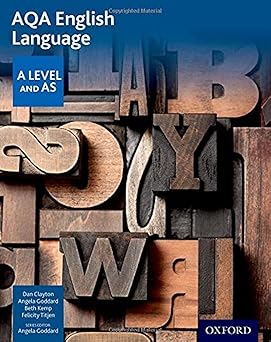
Yes. The course is written to be used alongside AQA A Level English Language: Student Book by Dan Clayton, Angela Goddard, Beth Kemp and Felicity Titjen, published by Oxford University Press. The ISBN is 978-0198334002, and reading references are provided throughout the course.
No. The course contains activities, assignments and suggested answers for independent study, but individual tutor marking is purchased separately. You can pay for selected assignments or purchase a marking bundle, depending on the support you need.
Yes. Optional support includes assignment marking, Email Tutor Support and one-to-one online tutorials. Tutorials can be used to discuss language-analysis techniques, examination preparation, investigation planning, original writing and the supervised coursework process.
Yes. The modules are arranged so that you learn the main methods of language analysis before applying them to more advanced topics and independent research. Students taking the full A-level are encouraged to begin the investigation module during the summer following their first year where possible.
Ready to begin?
Enrol at any time and begin working towards the AQA A-level English Language qualification through a structured, flexible home-study course.
Return to the enrolment panel to review today’s payment and add the course to your basket.