Institutional review
The order is recorded for institutional review and invoicing.

AQA A-level · Specification 7136
Explore how markets, businesses, governments and households make economic decisions. This structured two-year home-study course develops the analytical, quantitative and evaluative skills required for AQA A-level Economics.
£14.99 / month
For schools, colleges and local authorities
Choose the course access and support required for each learner. All options selected below apply to the number of identical learner places in this package.
Enter the number of learners who need the same course and package of support.
Add printed materials, assignment marking, practice exam marking or Annual Email Tutor Support as required.
Learner details are not required at checkout. Allocate each purchased place later through your institutional account.
Annual course access is included for every learner place. Add only the extra services needed by the learners in this package.
Please note: Assignment marking and Email Tutor Support are separate services. Email support covers brief questions and guidance; it does not replace assignment marking or individual tuition.
Package selection
The selections below apply to every learner place entered in this package.
Course overview
Study how individuals and firms make decisions, how markets allocate resources and why governments intervene in the economy. The course also examines inflation, unemployment, financial markets, economic growth, trade, globalisation and international economic relationships.
Qualification
A-level specification 7136, graded from A* to E.
Course structure
Two first-year modules are followed by two advanced second-year modules.
Recommended study time
This includes lesson study, textbook reading, activities, wider reading, assignments and examination preparation.
Recommended study period
A two-year timetable allows economic theory, diagrams, analysis and essay skills to develop progressively.
Marked course work
These are distributed throughout the course and followed by three A-level practice examinations.
Final assessment
Each paper lasts two hours and contributes one third of the final qualification.
Core skills
Apply economic models, interpret evidence and reach supported judgements about economic issues.
Coursework
The complete A-level is assessed through the three final written examination papers.
A-level Economics involves approximately 700 hours of study. Most students should therefore plan to complete the course over two academic years rather than compressing the full specification into a single year.
The first year establishes the main microeconomic and macroeconomic models. The second year applies these ideas to more complex markets, policy decisions and international economic issues.
Economic theory must be applied to the world beyond the textbook. Students should follow reliable reporting on inflation, interest rates, employment, government policy, financial markets, trade and economic growth.
Keeping a digital or paper collection of useful articles, statistics and examples can provide valuable material for data-response and essay questions.
Simply identifying an economic concept will gain limited credit. Students must explain logical links between causes and consequences, apply theory to the context provided and consider competing arguments before reaching a judgement.
The course introduction does not require GCSE-level Mathematics as a formal prerequisite. Students must, however, be comfortable with simple calculations, percentages, fractions, statistics and the construction and interpretation of economic graphs.
How the course works
Work through the lessons in sequence, using the Oxford Home Schooling course alongside the required textbook. Each module combines economic models, diagrams, calculations, activities, data-response questions and extended written analysis.
Study scarcity, markets, demand and supply, production, market failure and the basic operation of the national economy.
Follow the lesson explanations and activities alongside the specified textbook reading and self-assessment questions.
Use news, statistics and case-study evidence to examine how consumers, firms, governments and financial institutions respond to economic change.
Practise diagrams, calculations, multiple-choice questions, evidence-based analysis and balanced evaluative conclusions.
Optional extra support
Assignment marking, practice-paper marking, Email Tutor Support and one-to-one tutorials can be added when you need feedback on diagrams, calculations, analysis, evaluation or examination technique.
What you’ll study
The first year introduces markets, market failure and the operation of the national economy. The second year develops consumer behaviour, firms, labour markets, inequality, financial markets, trade, globalisation and international economic policy.
Modules 1 and 2 contain 14 lessons and cover the material required for the separate AQA AS Economics qualification 7135. They also form the foundation of the complete A-level course.
Modules 3 and 4 add 19 lessons. They deepen the analysis of consumers, firms and labour markets before moving into finance, government strategy, globalisation, trade and the European economic context.
Topics are divided into modules for convenience, but microeconomic and macroeconomic ideas frequently overlap. Later questions may require knowledge from several different parts of the course.
Work through the modules in order and continue revising earlier diagrams, definitions and analytical chains while studying the more advanced second-year material.
Exams and assessment
The full A-level is assessed through three two-hour written papers taken in the same examination series. Students answer data-response, essay, multiple-choice and case-study questions.
Paper 1
Paper 1 assesses individuals, firms, markets and market failure. Students choose one of two data-response contexts worth 40 marks and one of three essay questions worth 40 marks.
Paper 2
Paper 2 assesses macroeconomic performance, policy, financial markets and the international economy. Students choose one data-response context and one essay question.
Paper 3
Paper 3 is synoptic and can assess content from across the complete course. Section A contains 30 marks of multiple-choice questions and Section B is a 50-mark compulsory case study.
Examination timing
Marks from individual papers cannot be carried forward to a later examination sitting.
Coursework
The complete qualification is determined entirely through the three externally assessed papers.
Calculator use
Students should check the current AQA rules to ensure that their calculator is an approved examination model.
Assessment skills
Students must use qualitative and quantitative evidence to explain economic effects and support informed judgements.
Examination entry
Course enrolment does not automatically enter you for the examinations. Private candidates should locate an AQA-registered centre willing to enter them for A-level Economics specification 7136.
Confirm the centre’s entry arrangements, fees and deadlines well in advance of the examination series.
Support and add-ons
Your subscription provides the structured online course. Optional add-ons let you purchase written feedback, direct tutor contact, live explanations and printed materials when they would help.
Written feedback
Purchase marking for individual tutor-marked assignments and receive feedback on economic knowledge, calculations, diagrams, application, analysis and evaluation.
Assignment marking bundle£89.91
Exam preparation
Complete the A-level practice papers under timed conditions and purchase marking to identify strengths, misconceptions and priorities for final revision.
Practice examination marking bundle£85.50
Written tutor contact
Ask focused questions about an economic concept, calculation, diagram, data-response task, essay plan or examination answer.
Email Tutor Support£10.00 / month
Live support
Book a live tutorial for personalised explanation, quantitative support, diagram practice, essay development or focused examination preparation.
Tutorial time Purchased separately
Study your way
Add printed Oxford Home Schooling materials if you prefer annotating economic diagrams, calculations, data and essay plans on paper.
Printed course materials£50.00
Flexible support
Begin with the core course and add marking, tutor contact, tutorials or printed materials as your A-level Economics studies progress.
A-level Economics support
Prospective students can compare the available support services. Existing students can purchase A-level Economics marking, tutorials and other course-specific add-ons through their account.
Frequently asked questions
Find answers about study time, previous knowledge, Mathematics, the AS option, current affairs, assignments and the final examination papers.
The course represents approximately 700 hours of study. We normally recommend completing it over two years.
This allows time to develop diagram skills, quantitative confidence, economic analysis and extended evaluative writing.
No previous Economics qualification is required. The first module introduces economic methodology, markets, demand and supply before moving into more advanced theory.
The course introduction does not state a formal GCSE Mathematics requirement.
Students must nevertheless be able to use percentages and fractions, make simple calculations and construct or interpret graphs from economic data.
Yes. The first two modules also prepare students for the separate AQA AS Economics qualification 7135.
AS marks do not contribute towards the full A-level. Students continuing to A-level must still sit all three A-level papers.
There are three written papers. Each lasts two hours, carries 80 marks and contributes one third of the final qualification.
No. AQA A-level Economics is assessed entirely through the three final written examinations.
They are very important. Examination questions combine theory with real data and contemporary economic issues.
Students should follow reliable reporting on inflation, interest rates, employment, trade, growth, government policy and financial markets.
Yes. Students must construct, label and interpret diagrams such as demand and supply, costs and revenue, market structures and aggregate demand and aggregate supply.
A diagram should support the written analysis rather than replace it.
A strong answer applies accurate economic theory to the context, develops clear chains of reasoning and uses evidence or diagrams appropriately.
Evaluative answers should consider competing arguments, recognise relevant conditions and reach a supported judgement.
Regular assignments normally test a smaller group of recent lessons. Progress Tests cover a wider section of the course and contain a mixture of multiple-choice, data-response and essay-style questions.
Where possible, Progress Tests should be attempted under examination conditions.
Yes. Electronic calculators are permitted, subject to AQA’s current examination regulations.
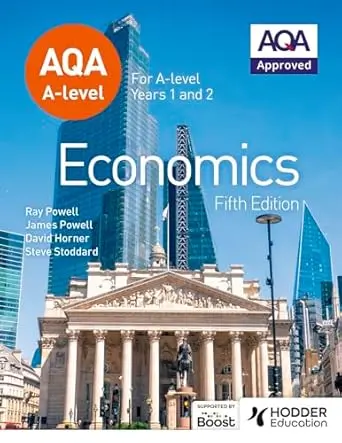
Yes. The course is designed to be studied alongside AQA A Level Economics by Ray Powell and James Powell.
The lessons and textbook complement one another, so some topics are covered more fully in one resource than the other.
Ready to begin?
Begin working towards AQA A-level Economics through a structured two-year home-study course covering markets, firms, government policy and the national and international economy.
Return to the enrolment panel to review today’s payment and add the course to your basket.